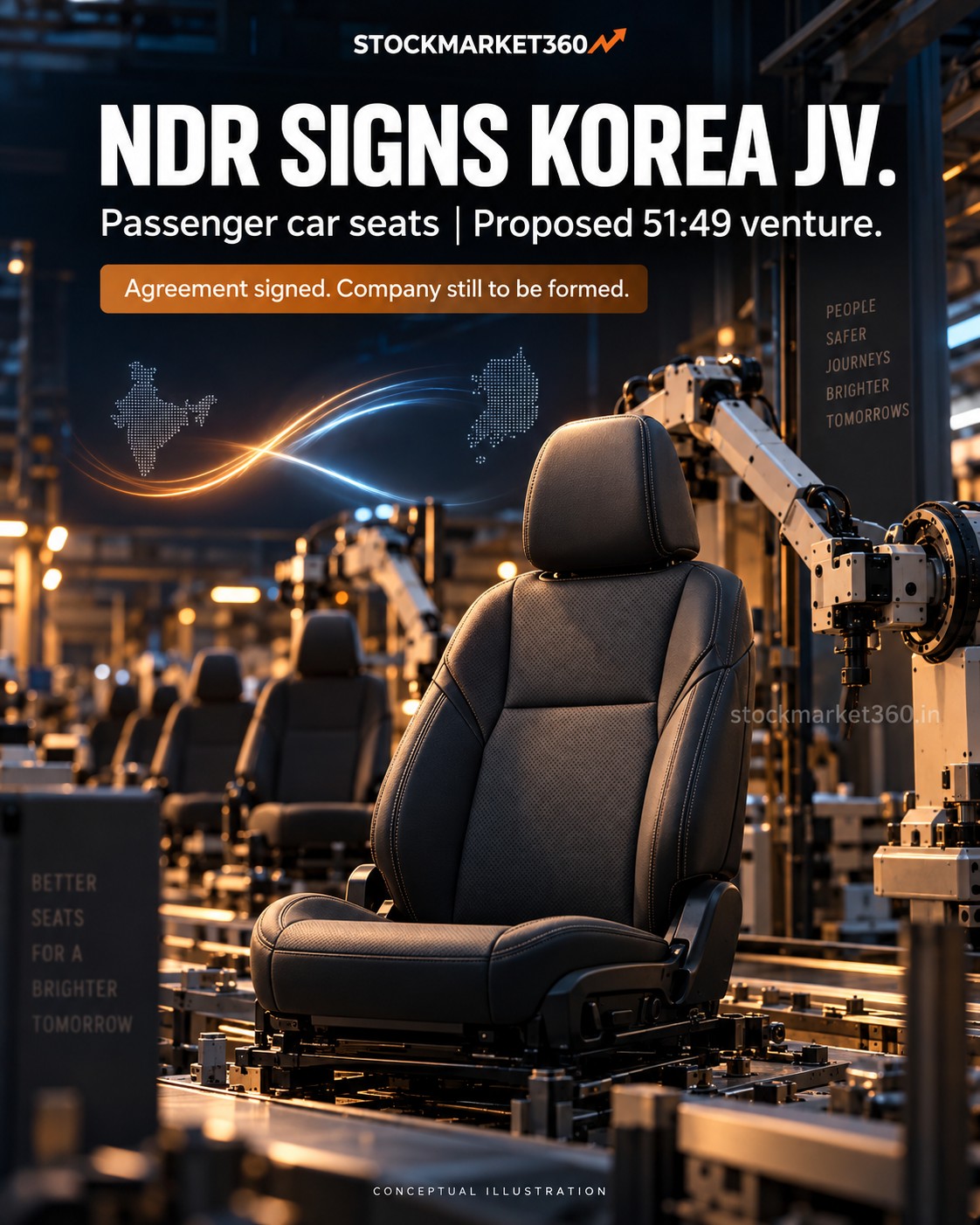
NDR Auto Components has moved its South Korea passenger-seat partnership from board approval to a signed agreement. The next milestone is different: forming the Indian company that will carry out the business.
In an exchange filing dated 17 November 2026, NDR said it executed a joint venture agreement with South Korea’s DYA Co., Ltd. that day. The agreement follows the approval disclosed after NDR’s board meeting on 4 November. The latest filing says the previously disclosed terms remain unchanged.
A signed pact, with incorporation still ahead
The proposed Indian company will design, manufacture and supply passenger car seats, primarily for Kia India and Hyundai India, according to NDR’s disclosure. NDR will hold 51% of its shares and DYA the remaining 49%.
The wording matters. The filing still describes a company proposed to be incorporated. It says that company will become an NDR subsidiary and related party upon incorporation. Signing the agreement is therefore a confirmed development; treating the proposed company as already incorporated goes beyond this update.
What the Rs 10 crore figure means
NDR identifies Rs 10 crore as the initial equity investment in the proposed joint venture company. That is a funding figure for the business being set up. It is not a customer order, a disclosed sales contract or revenue earned from supplying seats.
The same distinction applies to the 51:49 split. It describes the proposed ownership arrangement between the partners. The signing filing does not say that the initial equity has already been paid in, so the agreement should not be reported as confirmation that the funding has been received.
Customer focus is not a booked order value
Kia India and Hyundai India are named as the intended primary supply focus. Their names explain where the partnership wants to compete. The signing update does not disclose a purchase-order amount, seat volumes, a production-start date or an expected earnings contribution.
That leaves an important gap between the business plan and measurable delivery. A signed partnership can set the ownership and operating framework. Commercial progress will need to be assessed through later disclosures about incorporation, funding, manufacturing readiness and customer supply.
The development to track next
For readers following auto-component expansion, the fresh fact is that the agreement was executed on 17 November, rather than merely approved for signing. The 51% holding also sets out NDR’s intended majority position once the proposed company is formed.
The useful follow-up is evidence that the venture has moved into operation, with the scale and timing of supplies disclosed. Until then, this is a signed passenger-seat joint venture agreement with a defined ownership plan, not a quantified order win or an assured profit contribution.
The accompanying artwork is an original conceptual illustration, not a photograph of an NDR or DYA facility.