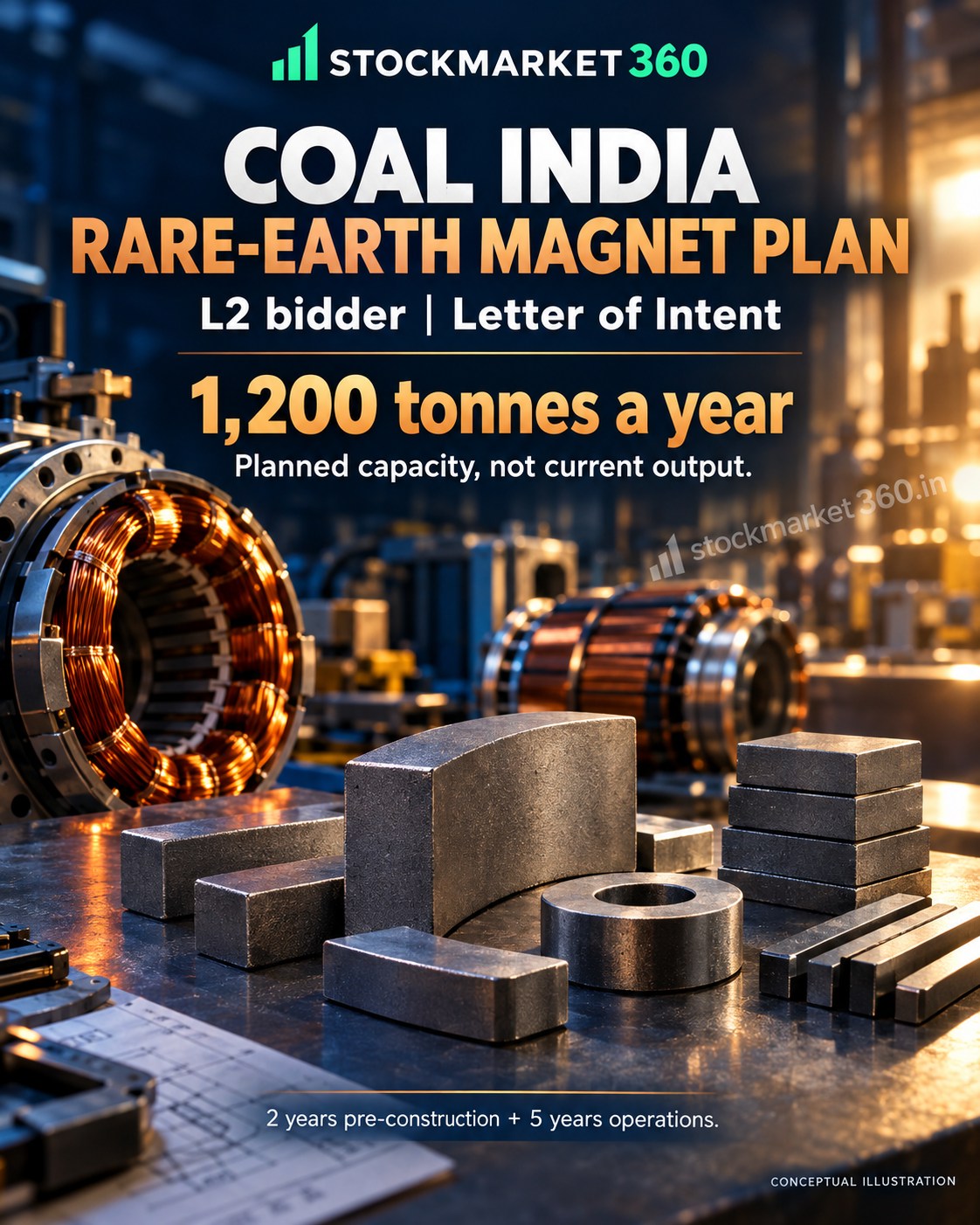
Coal India’s rare-earth magnet plan has reached the Letter of Intent stage. In a November 19, 2026 exchange filing, the company said the Ministry of Heavy Industries had declared its consortium the L2 bidder under the scheme to promote manufacturing of sintered rare earth permanent magnets.
Coal India is the lead member of the consortium with the Non-Ferrous Materials Technology Development Centre, or NFTDC. The proposed manufacturing facility would be set up through a special purpose vehicle. The filing identifies capacity of 1,200 tonnes per annum, not a rupee-valued sales contract.
What the disclosure establishes
The ministry’s Letter of Intent is dated November 19. The project concerns sintered neodymium-iron-boron, or NdFeB, permanent magnets. Coal India describes a seven-year period comprising two years of pre-construction and five years of operation.
That sequence separates the selection milestone from commercial production. The announcement does not say that a magnet factory is already operating, that 1,200 tonnes have been produced or that customers have placed orders for that volume. The annual capacity figure is a manufacturing target, not current output.
The filing also does not put a monetary value on Coal India’s investment, incentives or expected revenue. Nor does it disclose the SPV’s ownership split or identify a plant location. Those details remain open in this announcement.
The national scheme is larger than one company’s project
The Ministry of Heavy Industries’ August 13 update set out a national target of 6,000 tonnes per annum of integrated rare-earth permanent magnet capacity. It envisaged allocation to five beneficiaries through competitive bidding, with up to 1,200 tonnes per annum for each.
The same government update put the scheme’s financial outlay at Rs7,280 crore. That is the national programme’s budget. It is not the value of an order received by Coal India and should not be presented as money allocated to this consortium.
The government describes a seven-year scheme from the date of award: a two-year period to set up the facility followed by five years of incentives on magnet sales. Its stated objective is to build a domestic chain from rare-earth oxide to finished magnets, which are used in products including electric vehicles, wind turbines and electronics. These are potential end-use markets for the technology, not customer contracts disclosed by Coal India.
What to watch beyond the Letter of Intent
The immediate news is Coal India’s L2 status and receipt of the ministry’s Letter of Intent. Mint’s November 19 report, citing the tender process, says a letter of award follows performance guarantees and the required compliance. Coal India’s filing does not itself announce that later milestone.
Further disclosures on the award, SPV structure, investment and plant execution would make the project’s financial implications clearer. For now, the sound reading is a step into a proposed manufacturing venture, with construction and operations still ahead. The filing does not establish near-term revenue, margins or a profit contribution.
Sources: Coal India exchange filing, November 19, 2026; Ministry of Heavy Industries scheme update, August 13, 2026; Mint’s report on the selection process, November 19, 2026.